The Melitta Calibra is the best coffee grinder under £100 for most UK buyers. It combines conical steel burrs, 39 grind settings and an integrated scale, making it particularly useful for pour-over, AeroPress and cafetière coffee. Choose the AMZCHEF if espresso is the priority, the Krups Expert for a lower-cost electric option, or the Hario Mini Mill Plus for quiet manual grinding.
Every grinder below was available within the article’s £100 ceiling when checked. Prices and stock move, so use the retailer button to confirm the current offer. The recommendations focus on burr type, adjustment, dosing and brew-method fit rather than headline setting counts alone.
In This Guide
- Our direct answer
- Grinders at a glance
- Six grinder recommendations
- Burr vs blade
- Choose by brew method
- Electric vs manual
- Cleaning, retention and noise
- The Bottom Line
- Frequently Asked Questions
Best Coffee Grinder Under £100: Our Direct Answer
Buy the Melitta Calibra if you want one grinder for several filter methods and value repeatable weight-based dosing. Its scale removes one variable from a coffee recipe, while 39 settings give room to adjust when a brew runs too quickly or slowly.
For espresso, the AMZCHEF is the more appropriate design because it offers 48 settings and direct portafilter support. Under £100 still involves compromises: a grinder may reach a fine setting but leave too large a jump between neighbouring steps. Our guide to why cheaper grinders struggle with espresso explains that distinction.
Coffee Grinders Under £100 at a Glance
This comparison is CTA-free so you can decide which workflow fits before opening a retailer. Settings describe the manufacturer’s controls, not a promise of identical particle sizes between models.
| Grinder | Best for | Burr type | Adjustment | Key feature |
|---|---|---|---|---|
| Melitta Calibra | Best overall | Electric conical burr | 39 settings | Integrated scale |
| AMZCHEF 48-Setting | Best for espresso experimentation | Electric conical burr | 48 settings | Portafilter holder |
| Cuisinart Conical Burr | Best versatile option | Electric conical burr | 35 settings | Anti-static container |
| Krups Expert | Best budget electric | Electric burr | 17 settings | 2–12 cup selector |
| De’Longhi KG79 | Best simple electric | Electric burr | 16 settings | Compact controls |
| Hario Mini Mill Plus | Best manual and travel | Manual ceramic burr | Adjustable | 24g capacity |
Our Six Coffee Grinder Recommendations
1. Melitta Calibra — Best Overall

The Melitta Calibra is the strongest all-round choice under this article’s ceiling. Its conical steel burrs, 39 settings and integrated scale give filter-coffee drinkers more control than a basic cup-selector grinder. You can grind by weight, by cup count or manually, which is useful when alternating between a V60, AeroPress and cafetière.
The scale is the decisive feature: weighing the dose is more repeatable than asking a timer to approximate it. The large hopper suits households that value convenience, although beans generally stay fresher in an airtight container rather than sitting in a transparent hopper for days.
- Buy it if: you mainly make filter coffee and want weight-based dosing built in.
- Skip it if: you need a dedicated espresso grinder with very small adjustment steps.
- Main compromise: it uses most of the £100 budget and is taller than compact grinders.
2. AMZCHEF 48-Setting — Best for Espresso Experimentation

The AMZCHEF is the most espresso-oriented design in this shortlist. It has a 40mm conical burr, 48 numbered settings, timed dosing and holders for 51mm and 58mm portafilters. Those details make it easier to grind directly into a basket and make controlled adjustments than with a general-purpose grounds-bin grinder.
That does not make it equivalent to a premium stepless espresso grinder. Entry-level machines and pressurised baskets are more forgiving; an unpressurised basket may expose gaps between settings or changes as beans age. Treat it as a capable starting point, not a guarantee that every machine and coffee will dial in perfectly.
- Buy it if: you want direct-to-portafilter grinding and plan to learn espresso adjustment.
- Skip it if: you only brew cafetière or batch filter and prefer simple controls.
- Main compromise: espresso claims depend heavily on the machine, basket and beans.
3. Cuisinart Conical Burr — Best Versatile Option

The Cuisinart balances broad adjustment with uncomplicated daily use. Its 35 settings span fine to coarse, a 1–14 cup selector controls quantity, and the conical burr design is a sensible foundation for households that switch between moka pot, filter and cafetière.
The anti-static grounds container is useful because dry coffee can cling to plastic and scatter across the counter. It will not remove every trace of static, which varies with roast, humidity and grind size, but it addresses a common annoyance. The removable hopper and supplied brush also make routine cleaning more approachable.
- Buy it if: several people use different brew methods and want one electric grinder.
- Skip it if: an integrated scale matters more than the cup selector.
- Main compromise: it is a generalist rather than a specialist espresso grinder.
4. Krups Expert — Best Budget Electric

The Krups Expert is the sensible low-cost electric pick. It uses burrs rather than a chopping blade, offers 17 grind positions and can stop automatically after the selected 2–12 cup quantity. That is enough adjustment for ordinary filter, moka pot and cafetière use without turning every morning into a calibration exercise.
Seventeen settings give less room for fine tuning than the Melitta, Cuisinart or AMZCHEF. The cup selector is also a convenience control rather than a substitute for weighing coffee. Use a small digital scale if recipe consistency matters.
- Buy it if: you want a familiar electric burr grinder at the lower end of the budget.
- Skip it if: you frequently change beans or need close espresso adjustment.
- Main compromise: fewer grind steps limit precision.
5. De’Longhi KG79 — Best Simple Electric
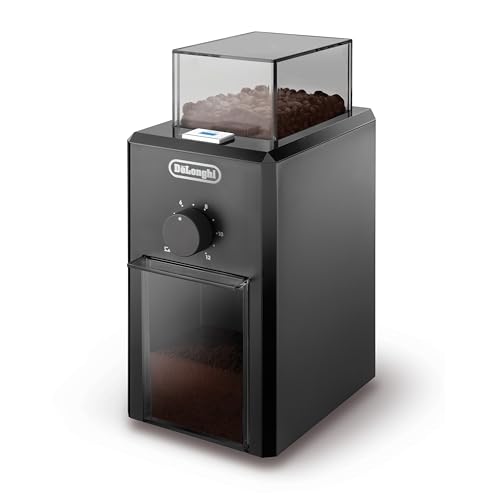
The De’Longhi KG79 is for buyers who want clear physical controls and no display. One dial selects among 16 grind levels, another selects the quantity, and the removable grounds container keeps the workflow familiar. Its narrow body also occupies less visual space than larger hopper grinders.
It is best viewed as an accessible filter grinder. The finest label on a dial does not prove that a grinder will suit every espresso basket, and broad stepped adjustment can make precise dialling-in difficult. For cafetière, drip and moka-pot drinkers, the simple controls are the appeal.
- Buy it if: you want an established electric model with simple controls for everyday coffee.
- Skip it if: you want direct-to-portafilter dosing or dozens of settings.
- Main compromise: its adjustment range is less granular than newer rivals.
6. Hario Mini Mill Plus — Best Manual and Travel

The Hario Mini Mill Plus is the only manual grinder here. Its ceramic burrs, adjustable setting and 24g capacity suit one or two cups, travel and kitchens where noise or storage matters more than speed. The plastic body avoids the breakage risk of a glass catch jar.
Hand grinding gives you burr quality without paying for a motor, but it costs time and effort. Fine settings take longer, and the small capacity is inconvenient for a large cafetière. It makes most sense for AeroPress, pour-over or occasional brewing rather than a household making several cups at once.
- Buy it if: you make one or two cups and value portability, quietness and compact storage.
- Skip it if: you need to grind a large dose quickly every morning.
- Main compromise: manual effort and limited capacity.
Burr vs Blade: Where to Spend the Budget
A burr grinder moves beans through a controlled gap between two abrasive surfaces. Changing that gap changes the grind size. A blade grinder repeatedly chops beans in a chamber, so its result depends on time, movement and how often particles return to the blade.
That difference matters because small particles extract quickly while large particles extract slowly. A broad mix can taste bitter and weak at once. No affordable grinder produces perfectly identical particles, but a burr mechanism gives you a controllable starting point. This shortlist therefore excludes electric blade mills, even though some cost less.
Conical and flat burr labels do not settle the buying decision by themselves. Alignment, geometry, motor speed and the adjustment mechanism also affect performance. At this budget, choose the grinder whose usable range and workflow match your brewer.
Choose a Grinder by Brew Method
Espresso
Espresso needs both a fine grind and close control. A tiny change can alter how quickly water passes through the puck. The AMZCHEF has the most suitable workflow here, but buyers using an unpressurised basket should understand that a dedicated grinder above this budget may be easier to dial in. Read our guide to fine grind control before choosing on the word “espresso” alone.
Filter and Pour-Over
Pour-over rewards repeatable medium-to-fine adjustment. The Melitta’s scale is useful because it lets you hold dose constant while changing grind size. The Cuisinart provides a broad general-purpose range, while the Hario is practical for a single cup. Use brew time and taste to guide changes rather than copying an arbitrary dial number from another grinder. Our guide to adjusting a grinder gives a simple process.
Cafetière and Cold Brew
These methods generally use coarser settings and larger doses. Electric grinders are more convenient when preparing several cups. The Melitta, Cuisinart, Krups and De’Longhi all avoid the slow manual work of grinding a full cafetière dose. Do not assume the coarsest possible setting is automatically correct; excessive coarseness can leave coffee thin.
The Specialty Coffee Association’s standards resources are useful context, but home grinders do not share universal dial numbers. Calibrate using your own brewer, dose, water and taste.
Electric vs Manual Under £100
An electric grinder wins on speed and household convenience. It is the better choice for several cups, frequent switching between users, or mornings when hand grinding would discourage you from using fresh beans. Timers and cup selectors simplify quantity, although a separate scale remains more accurate.
A manual grinder directs more of the price towards burrs and bearings because there is no motor or control board. It is quieter, easier to store and useful away from a socket. The trade-off is effort, especially at finer settings. Compare the routines in our manual vs electric grinder guide.
Cleaning, Retention and Noise
Old grounds trapped around the burrs can make fresh coffee taste stale. Brush accessible areas regularly, empty the grounds path and follow the model’s manual before removing burrs. Never wash a motor unit, and do not put burrs in water unless the manufacturer explicitly says they are washable. Our calibration guide also explains why you should note a working setting before dismantling the adjustment.
Retention is the coffee left inside after grinding. A short purge may reduce carry-over when changing beans, but it also wastes coffee. Static can make fine, dry grounds cling to the container; humidity, roast and material all affect it. Anti-static design helps without eliminating every speck.
Electric grinders are brief but noticeable appliances. If early-morning noise matters, a hand grinder is the safest choice. Placement also changes perceived noise: a hollow worktop can amplify vibration. See our guide to quieter grinder choices.
The Bottom Line
The Melitta Calibra is the best all-round coffee grinder under £100 in this shortlist because its conical burrs, 39 settings and integrated scale support a repeatable filter-coffee routine. The AMZCHEF is the better espresso-oriented choice, while the Krups Expert covers basic electric grinding at a lower spend.
Choose the brewer first, then the grinder. A modest burr grinder that is easy to adjust and clean will improve daily coffee more reliably than a feature-heavy model whose range does not suit your method.
Frequently Asked Questions
What is the best coffee grinder under £100? The Melitta Calibra is the best all-round option here for filter coffee because it combines conical steel burrs, 39 settings and an integrated scale. Espresso-focused buyers should consider the AMZCHEF, with realistic expectations about stepped adjustment.
Is a burr grinder better than a blade grinder? A burr grinder is usually the better choice because it controls the gap through which beans pass. A blade grinder chops for a length of time, producing a less controlled mixture of particle sizes.
Can a coffee grinder under £100 grind for espresso? Some can grind finely enough for certain machines, especially those using pressurised baskets. Fine enough is not the whole test: the adjustment steps must also let you control shot flow with your coffee and basket.
Is a manual grinder better value under £100? A manual grinder can put more of the budget into the burrs because it has no motor. It is good value for one or two cups, but electric models are faster for larger doses and shared households.
How many grind settings do I need? The number alone does not determine quality. Filter brewing needs a useful coarse-to-medium range, while espresso benefits from many closely spaced fine adjustments. Repeatability matters more than an inflated setting count.
How often should I clean a coffee grinder? Brush loose grounds out regularly and clean removable parts according to the manufacturer’s instructions. Avoid putting water near burrs or motors unless the manual explicitly permits it, and deep-clean more often when using oily beans.