Most home coffee grinder burrs last years rather than months, but the useful answer depends on what you grind, how often you grind it, and whether you are chasing espresso consistency or just decent cafetiere coffee. For a normal UK home setup, the coffee grinder burr lifespan is usually about 3-7 years for entry-level electric grinders, 5-10 years for better steel burr grinders, and often longer for light-use hand grinders.
In This Article
- The Short Answer on Burr Lifespan
- Coffee Grinder Burr Lifespan by Grinder Type
- What Worn Burrs Actually Change in the Cup
- How to Check Burrs Before You Replace Them
- Replacement Costs and When It Is Worth Doing
- How to Make Grinder Burrs Last Longer
- Frequently Asked Questions
The Short Answer on Burr Lifespan
If you make one or two coffees a day, your burrs are probably not the first thing to blame when coffee tastes off. Old beans, poor grind setting, stale residue and a dirty chute usually cause more trouble than worn metal.
That said, burrs do wear. They lose their sharp cutting edges, crush more than they slice, and produce a wider spread of particles. The frustrating bit is that this happens slowly. There is rarely a single morning where the grinder suddenly tastes bad.
Useful home-use ranges
For UK home users, these are realistic working ranges:
- Budget blade grinder: no burrs to replace; the upgrade is a burr grinder, usually from about £45-£90.
- Entry electric burr grinder: about 3-5 years for daily use, longer for filter-only use.
- Espresso-capable electric grinder: about 5-10 years for a typical home setup, depending on burr size and roast level.
- Good hand grinder: often 5-10+ years because it sees lower heat and lower throughput.
- Commercial-style burrs in a home grinder: can outlast the rest of the grinder if you only dose 18-40g a day.
The coffee grinder burr lifespan shortens if you grind oily dark roasts every day, run supermarket beans with occasional stones or foreign bits, or use one grinder for both espresso and large-batch filter. It lengthens if you single-dose clean beans and brush the grinder every few weeks.
Espresso notices wear first
Espresso is less forgiving than filter. A burr set that still makes a pleasant cafetiere can be annoying for espresso because small particle changes alter shot time, flow and bitterness. If you are constantly moving the dial finer and still getting fast, thin shots, worn burrs move higher on the suspect list.
Filter coffee hides wear for longer. Pour-over may lose clarity, but it does not punish you in the same immediate way as espresso. French press is even more forgiving because the grind is coarse and immersion brewing smooths out some inconsistency.
My own rule is simple: clean first, recalibrate second, replace third. Burrs are not cheap enough to use as a first guess.
Coffee Grinder Burr Lifespan by Grinder Type
The burr material, burr size and grinder design matter more than the age printed on your receipt. A £65 grinder used twice a day for espresso is working much harder than a £500 single-dose grinder making one V60 in the morning.
Entry-level electric grinders
Grinders such as the Baratza Encore, Wilfa Svart and Sage Dose Control Pro are usually bought for filter, AeroPress, cafetiere and occasional moka pot use. In that role, they can last a long time.
The wear point is not always the cutting burr itself. On some entry grinders, plastic carriers, adjustment rings and motor strain show up before the burr teeth are truly blunt. Baratza sells replacement parts and lists the Encore ring burr and holder at $16.95 on its US support site; UK buyers are pointed towards Coffee Hit through Baratza’s international parts page. In practice, UK parts pricing varies, but expect roughly £15-£35 for smaller holders or burr-related parts before delivery.
For an entry grinder, I would not replace burrs just because it is three years old. I would replace them if:
- The grind has become visibly uneven after cleaning and recalibration.
- The grinder needs much finer settings than it used to for the same beans and brew method.
- The part cost is sensible compared with a new grinder, usually under about a third of replacement cost.
If the grinder cost £90 and the repair bill is £45 plus postage, think hard. If the grinder cost £150-£180 and the burr-related part is £20-£30, repairing it is much easier to justify.
Espresso grinders
Espresso burrs live a harder life because they work at finer settings. They also get judged more harshly. A small loss of sharpness can show up as muddier flavour, more channeling and a narrower sweet spot.
This is where the difference between cheap and good grinders becomes obvious. In our Niche Zero vs DF64 vs Eureka comparison, the more serious grinders make sense partly because they are serviceable. You are not buying a sealed kitchen gadget. You are buying a machine that can be opened, cleaned and kept going.
The Niche Zero, for example, uses 63mm conical burrs and currently costs £499 in the UK direct from Niche. Replacement Mazzer-style burr sets are not impulse purchases; depending on supplier and availability, UK buyers should expect a rough £70-£130 range for compatible premium burrs. That sounds a lot until you compare it with replacing the whole grinder.
For espresso, replacement becomes worth considering when the same beans, same dose and same machine become harder to dial in week after week. If you are changing coffee every few days, do not blame burrs too quickly. Some beans are just awkward.
Hand grinders
Good hand grinders often have an easier life. They grind smaller quantities, run cool and have fewer electrical parts to fail. A £70-£100 Timemore-style hand grinder used for AeroPress or travel coffee may keep going for years before burr wear matters.
Cheap ceramic-burr hand grinders are different. The issue is usually wobble, slow grinding and poor alignment rather than pure burr wear. If a £25 grinder takes ages and produces boulders and dust from day one, new burrs will not save it. Put the money towards a better hand grinder.
If you want one grinder for travel, office coffee and occasional camping, a decent hand grinder is still a good buy. Just be honest about effort. Grinding 30g for cafetiere by hand every morning gets boring quickly.
What Worn Burrs Actually Change in the Cup
Worn burrs do not simply make coffee “weaker”. They change particle consistency, which changes extraction. That can taste like bitterness, sourness, flatness or muddiness depending on the brew method.
More fines and boulders
Sharp burrs cut beans into a tighter range of particle sizes. Worn burrs tend to crush and smear more, creating extra fines alongside larger fragments.
That matters because:
- Fines over-extract and can taste bitter, dry or muddy.
- Large particles under-extract and can taste sour, thin or grassy.
- Mixed particles make recipes harder because one grind setting cannot suit everything in the basket or brewer.
This is why a worn burr grinder can make coffee taste both bitter and sour. It is not magic. It is uneven extraction.
Espresso gets harder to control
With espresso, the signs are more obvious. You may notice:
- Fast shots at unusually fine settings, even after cleaning.
- More channeling, especially with lighter roasts.
- Less sweetness from beans that used to taste round and balanced.
- More clumping, although static and humidity can cause this too.
Before blaming burrs, check the simple stuff from our espresso dialling-in guide: dose, puck prep, basket size, bean age and machine temperature. A grinder can only do its job if the rest of the setup is not fighting it.
Filter coffee loses clarity
In pour-over and batch filter, worn burrs usually show as less separation between flavours. You might still get a pleasant mug, but the coffee tastes more generic. Floral coffees become dull. Bright coffees become sharp but not sweet.
If that sounds familiar, clean the grinder before spending money. Old coffee oil sitting around the burr chamber can flatten flavour in a way that feels like burr wear. I have seen grinders improve massively after a proper brush-out and purge, which is annoying if you have already convinced yourself you need shiny new burrs.
How to Check Burrs Before You Replace Them
Do not judge burrs by age alone. Judge them by condition and performance. A grinder that has only seen one bag a month for three years is not the same as one grinding 60g every day for espresso and filter.
Step 1: clean the grinder properly
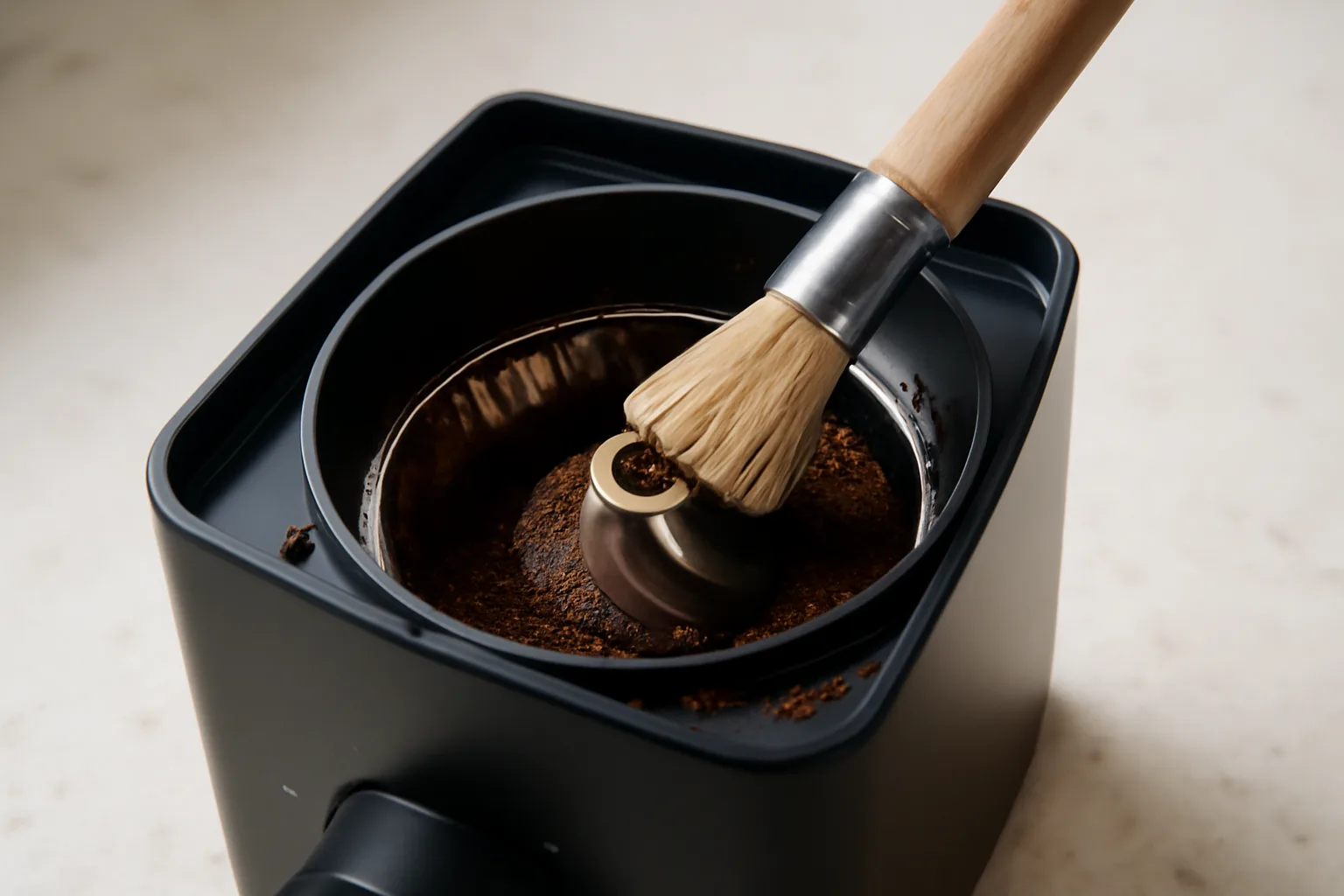
Unplug the grinder, remove the hopper and upper burr if the design allows it, then brush out the chamber. Use a wooden cocktail stick or soft brush for packed grounds. Avoid water unless the manufacturer specifically says a part is washable. If the problem started after switching brew methods, our guide to choosing a grinder for espresso vs filter is worth checking before you assume the burrs are worn.
Our grinder burr cleaning guide goes into the cleaning process in more detail, but the short version is this: remove old grounds, remove oil build-up, then put the grinder back together carefully.
I am cautious with grinder cleaning pellets. They can help with oily residue, but they are not a substitute for opening the grinder and checking what is actually inside. A £10-£15 tub is useful for maintenance; it should not become an expensive ritual you do every week.
Step 2: inspect the burr edges
Use a bright light. You are looking for edges that look rounded, polished smooth, chipped or uneven. Some dark staining is normal. Coffee oils mark metal. That is not the same as damage.
Do not run your finger hard across the burr teeth. Burrs can still cut skin, and you do not learn much from poking them. Look for obvious changes:
- Shiny rounded cutting edges rather than crisp ridges.
- Chips or missing teeth, usually caused by foreign material in beans.
- Uneven wear on one side, which can point to alignment or carrier problems.
- Loose carriers or cracked plastic, especially on entry-level grinders.
If the burrs look fine but the grinder sounds strained, the issue may be motor, gearbox or alignment rather than burr wear.
Step 3: test with familiar beans
Use a coffee you know well, ideally roasted 1-4 weeks ago. Keep the recipe boring and repeatable: same dose, same water, same brew method.
For espresso, note the setting, shot time and taste. For filter, note brew time and drawdown. If you need a much finer setting than usual and the cup still tastes thin or muddy, burr wear becomes plausible.
Do not test with supermarket beans of unknown age and then make a repair decision. Stale beans are brilliant at pretending your equipment is broken.
Replacement Costs and When It Is Worth Doing
The repair decision is part performance, part maths. Burr replacement makes sense when the grinder is otherwise good, the parts are available, and the total cost is comfortably lower than buying a better grinder.
Typical UK cost ranges
Use these as practical buying ranges, not fixed quotes:
- Cleaning brush and basic maintenance bits: £5-£15 from Amazon UK, Coffee Hit or Bella Barista.
- Grinder cleaning pellets: about £10-£18 for a small tub.
- Entry burr holders or small replacement parts: roughly £15-£35 depending on model and postage.
- Replacement burr sets for better home grinders: commonly about £35-£90.
- Premium burr sets: about £70-£160+ depending on size, coating and compatibility.
- New entry electric burr grinder: about £80-£170 from Amazon UK, John Lewis, Lakeland or specialist coffee shops.
- Serious espresso grinder: roughly £300-£700+ from Bella Barista, Coffee Hit, Niche or similar UK suppliers.
The annoying bit is availability. Some brands make parts easy. Others make you hunt through importers or email support. Baratza is one of the better examples for supportability; its official parts pages list individual parts, and its international support page points UK users to Coffee Hit.
When I would replace burrs
I would replace burrs when all four of these are true:
- The grinder was good when new and still suits how you brew.
- Cleaning and recalibration did not fix it, so you have ruled out the obvious causes.
- The burrs are visibly worn or damaged, or performance has clearly drifted with familiar beans.
- The repair cost is sensible, ideally under 30-40% of the cost of replacing the grinder.
For a Baratza Encore used for filter, a sensible parts repair can be worth it. For a no-name £50 burr grinder, I would usually move on. For a Niche, Eureka, DF64, Sage Smart Grinder Pro or similar, I would inspect and repair before replacing the whole machine.
When I would upgrade instead
Replace the grinder, not the burrs, if the original grinder never suited your brewing. A cheap stepped grinder that cannot dial in espresso will not become an espresso specialist because you fitted fresh burrs. It will become a slightly fresher version of the same limited grinder.
This is the same point we make in our manual vs electric grinder guide: the right grinder type matters before fine tuning. If you mostly make espresso, buy for adjustment precision. If you mostly make cafetiere, do not overspend chasing espresso features you will never use.
How to Make Grinder Burrs Last Longer
Burrs are wear parts, but you can make them wear slowly. Most of it is boring maintenance. Sorry. The boring bits work.
Keep oily residue under control
Dark roasted beans leave more surface oil. That oil collects around burrs and chutes, traps fines and makes the grinder work harder. You do not need to avoid dark roast completely, but you should clean more often if you use it.
For daily dark roast espresso, check the burr chamber every 2-4 weeks. For lighter filter roasts, every 6-8 weeks is often enough. If the grinder smells stale when empty, clean it.
Do not grind unknown beans
Small stones and hard foreign bits are rare, but they do happen. They can chip burrs in one bad moment. If you buy very cheap beans or green beans roasted at home, be more careful about checking them before they go in the hopper.
That does not mean you need to inspect every bean like a jeweller. Just do not pour a mystery bag into a £500 grinder without looking.
Avoid using the grinder as storage
Leaving beans in the hopper for days is convenient, but it exposes them to air and keeps oil sitting in the grinder. Single dosing is cleaner, especially on grinders designed for it.
If you use a hopper grinder, only load what you expect to use soon. Store the rest in an airtight bag or canister away from heat. Fresh beans protect flavour; cleaner beans protect the grinder.
Use the right grind range
Running a grinder at its extreme finest setting all the time can increase strain, especially on cheaper machines. If a grinder is always choking, stalling or sounding unhappy, it may not be the right grinder for that brew method.
For espresso, this is where an espresso-capable grinder earns its keep. For filter, a modest burr grinder is fine. Do not ask a budget filter grinder to behave like a cafe espresso grinder and then blame the burrs when it complains.
Frequently Asked Questions
How long do coffee grinder burrs last at home? For most UK home users, coffee grinder burrs last about 3-7 years in entry electric grinders and 5-10+ years in better grinders. Espresso use, dark roasts and poor cleaning shorten that range.
How do I know if my grinder burrs are worn? Look for rounded or chipped edges, more fines and boulders, familiar beans tasting muddy, and espresso shots needing much finer settings than before. Clean and recalibrate before deciding.
Is it worth replacing burrs on a cheap grinder? Usually not if the grinder cost under about £70 and never performed well. It can be worth it on serviceable grinders where parts cost roughly £15-£40 and the grinder still suits your brew method.
Do ceramic burrs last longer than steel burrs? Ceramic burrs can resist wear well, but they can be brittle and are often found in cheaper hand grinders with weaker alignment. Steel burrs in a well-built grinder are usually the safer home choice.
Can cleaning make old burrs feel sharp again? Cleaning cannot restore worn metal, but it can remove stale oil and packed grounds that mimic burr wear. Always clean before buying replacement parts.
Do espresso grinders wear burrs faster than filter grinders? Espresso use tends to reveal wear earlier because fine grinding needs tighter particle control. The burrs may not be ruined, but espresso becomes harder to dial in before filter coffee tastes obviously bad.