Thermal vs glass carafe filter coffee machines comes down to when the coffee is poured. If everyone drinks the batch as soon as it finishes, a glass jug is simple and easy to see into. If cups are taken over a longer morning, a thermal jug gives the batch a better chance of staying pleasantly warm without sitting on a powered hotplate.
In This Article
- Thermal vs glass carafe filter coffee machines: the short answer
- How the two designs keep coffee warm
- Taste and temperature over a serving window
- Brewing for one person or a household
- Cleaning and everyday handling
- Breakage, spare jugs and machine fit
- What to check before buying
- Which carafe should you choose
- Frequently Asked Questions
Thermal vs glass carafe filter coffee machines: the short answer
Choose a thermal-carafe filter machine when coffee is brewed once and poured in stages: one cup before the school run, another after a call, perhaps a third for somebody who gets up later. Choose a glass-jug machine when the batch is served promptly and you value seeing the remaining coffee and cleaning a wide, simple vessel. A hotplate can keep a glass jug warm for a while, but it is an active heat source; the thermal jug slows heat loss instead. That difference is the heart of the comparison.
Match the carafe to the serving pattern
- Serve immediately: glass is a sensible, often simpler choice; switch off the hotplate once the jug is empty.
- Serve across the morning: thermal is the stronger starting point, provided the jug seals well and is preheated if its maker recommends it.
- Want to see the fill level: glass wins at a glance; thermal requires opening or judging by weight.
- Worried about a broken jug: compare the exact spare-part availability alongside the material printed on the box.
My default for a household that brews a full batch and returns to it is thermal. For a small batch poured straight into two mugs, I would save the complexity and choose glass, assuming the machine itself brews well. The carafe cannot rescue poor brewing. Water distribution, brew capacity and ease of cleaning still matter, as our coffee machine features guide explains for the broader purchase.
How the two designs keep coffee warm
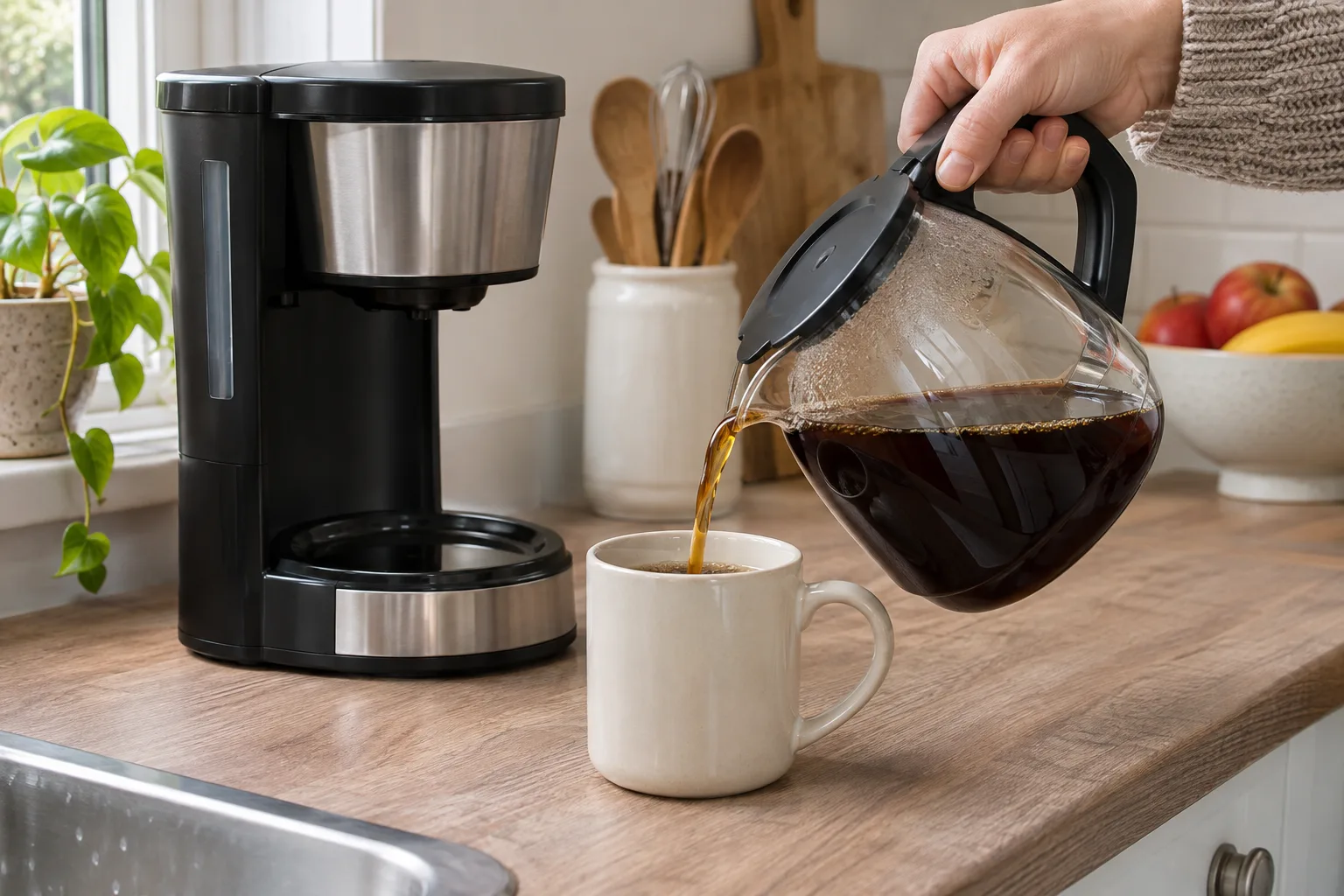
A glass jug gives you visibility and a simple pouring vessel, but glass offers limited insulation. Many glass-carafe filter machines therefore include a warming plate beneath the jug. The plate supplies heat after brewing, usually until a timed switch-off. It is a holding feature rather than a second brewing stage. Removing the jug to pour and returning it to the plate is easy, though the base and plate can remain hot. Follow the exact model’s instructions rather than assuming every plate runs for the same duration.
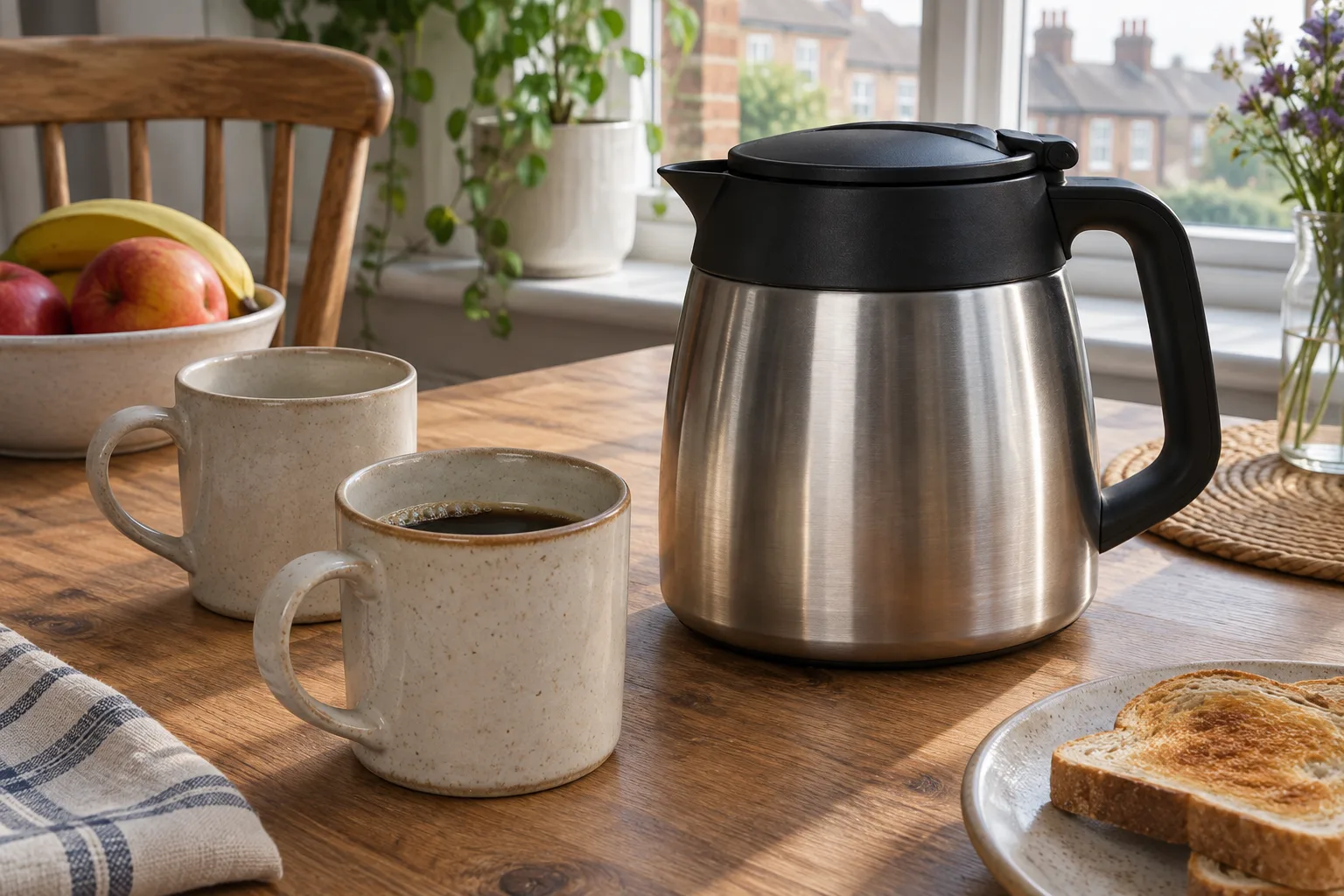
A thermal carafe uses an insulated wall, commonly stainless steel, to slow cooling. It needs no heat from the machine once brewing finishes. Lid design is crucial: a poorly seated or frequently opened lid lets heat escape, while a well-fitted one helps maintain a useful serving temperature. The carafe is more like a table flask than a glass jug left on a cooker. Its outside may feel relatively cool even when the coffee inside is hot, so handle a freshly brewed batch with care.
Heat retention is conditional
The best choice depends on the temperature at which coffee enters the carafe, how much is brewed, whether the vessel is already cold and how often it is opened. A nearly full thermal jug usually holds heat better than a small amount of coffee surrounded by unused space, but the result varies with its construction. Rinsing a thermal jug with hot water, emptying it and brewing straight away can reduce the initial heat lost to cold metal. Wilfa’s thermal-versus-glass guidance makes that preheating point for its own equipment. Apply that guidance to the maker’s equipment; performance varies across brands.
For glass, a preheated cup can help a small serving feel warmer without asking the hotplate to hold a whole batch. A hotplate is particularly tempting when the kitchen is cool in winter, yet prolonged heating can change a brewed coffee’s flavour. If everyone drinks promptly, the plate may be unnecessary. If nobody knows when the second cup will happen, insulation is often a better fit.
Brewing heat and holding heat differ
A machine’s brew-water temperature affects extraction; the carafe determines what happens after the coffee lands. The two questions are related but separate. Under-extracted coffee still tastes unbalanced in a thermal jug, while a glass jug alone cannot explain bitterness. For the extraction side, read our coffee temperature guide. In this decision, focus on the interval between finished brew and last cup, and on how the coffee is held during that interval.
Taste and temperature over a serving window
Freshly brewed filter coffee changes as it sits. Aroma fades, temperature falls and oxygen exposure continues regardless of carafe. A thermal jug reduces cooling while avoiding continuous heat from a plate. A glass jug on a warming plate may feel hotter later, but a hotter cup may taste less fresh. How fast the flavour changes depends on the brew, plate behaviour and holding time, so claims that one material guarantees a specific taste after two hours are too sweeping.
The first cup and the last cup
For a first cup poured immediately, a well-made thermal machine and a well-made glass machine can both deliver enjoyable coffee. The brewer’s extraction and fresh beans are likely to matter more than the jug material. The gap widens when cups are spread out. A covered thermal jug is a reasonable way to keep a batch for a second serving without adding heat. A glass jug on a hotplate maintains temperature through active warming, while the flavour can become flatter or harsher as the coffee remains hot and exposed.
A thermal carafe can still disappoint if it was cold at the start, the lid is loose or the small remaining amount cools quickly. Glass can suit a later cup if you remove the jug from the plate and accept a cooler drink, or pour the remainder into a separate insulated flask. Those are practical options, but buying a machine whose built-in carafe matches your normal routine is less fiddly.
Taste is personal, claims need limits
We have not run a controlled side-by-side taste test of these machines. The recommendation here follows their heating and insulation methods, manufacturer instructions and the way a household serves a batch. It would be wrong to say every thermal jug preserves every flavour note, or every glass machine “burns” coffee within a fixed number of minutes. Glass itself does not spoil the brew; repeated or prolonged heating is the relevant concern. Nor does stainless steel automatically improve a drink if the brewer’s temperature or coffee-to-water ratio is off.
Before changing machines to fix a disappointing cup, check the fundamentals. Our coffee-to-water ratio guide is useful when a whole pot tastes too weak or heavy from the first pour. Carafe choice is a holding decision. Bean freshness, grind and brewing remain separate levers.
Brewing for one person or a household
The number of cups printed on a filter machine can be misleading because “cup” may mean a small serving rather than your favourite mug. Compare the jug’s stated capacity in litres with the actual volume your household drinks. If you routinely brew one large mug, a huge insulated carafe may be awkward to fill and clean. If two people drink three mugs over a morning, a small glass jug may force repeated brewing or leave the last cup sitting on a plate.
One quick batch
Glass is easy to recommend when the coffee goes directly from machine to mugs. You can see the fill level, watch the end of the brew and rinse the jug after use. The hotplate can be switched off or allowed to time out according to the machine’s instructions. A thermal jug adds a lid and often a narrower opening without giving much benefit when nothing remains to hold. If you brew only a half-jug, confirm the machine is designed to perform well at that volume rather than assuming a smaller batch will extract identically.
For a solo drinker who wants a fresh cup each time, even a filter machine with the perfect carafe may be the wrong format. A smaller brewer or a manual method could produce less leftover coffee. Our pour-over versus French press versus AeroPress guide compares those routines. This article stays with the choice between two carafe designs once a batch filter machine is the plan.
Staggered cups and shared kitchens
Thermal is more convincing when a batch serves people at different times. It can be carried to a table or desk without relying on the machine’s plate, provided the maker allows that use and the lid is secure. It also frees the brewer’s spot for cleaning once brewing ends. If people repeatedly open the lid to inspect the level, however, some of the heat-retention advantage is lost. Learn the pouring mechanism and keep it closed between cups.
An office may need more capacity and a different cleaning routine than a household, and a jug that goes missing between desks can be a nuisance. Our office coffee machine guide covers that wider choice. At home, write down the time from first to last cup on a normal weekday. That ordinary detail often settles the carafe debate more clearly than a specification sheet full of temperature claims.
Cleaning and everyday handling
A glass jug lets you see coffee residue and, depending on its opening, reach inside with a soft sponge. Avoid abrasive tools and thermal shock; follow the maker’s dishwasher advice rather than assuming every glass jug or handle assembly is dishwasher-safe. The hotplate needs a wipe after it has cooled, especially if coffee has dripped under the jug. Cleaning effort is modest when the jug is emptied soon after use.
Thermal carafes often have a narrower neck and a lid with seals or channels. Those parts can trap old coffee oils or drips if they are neglected. Rinse the jug after every batch, wash according to the manual and let the components dry fully before reassembly. A bottle brush may help with an opening too narrow for a hand. Do not assume the entire insulated vessel belongs in a dishwasher; many makers specify handwashing, while lid parts may have different instructions.
Pouring and visibility
Glass makes the remaining volume obvious. It is useful when someone wants to know whether there is enough for another mug without disturbing the brew. With thermal, you may have to lift the carafe, open it or track how many cups were poured. That sounds minor until several people share a batch and everybody leaves a small amount behind. A lid that twists or uses a press lever may also be awkward for someone with limited hand strength; try the mechanism in a shop if this matters.
A thermal jug can be pleasant at the table because the outside is easier to handle and the coffee is separated from the machine. But spouts and lids differ sharply between models. Look for reports of drips, how the last portion pours and whether the lid can be cleaned without tools. A glass jug may pour more predictably, yet its handle and rim can be fragile. The particular design can outweigh a general statement about either material.
Scale and old coffee oils
Both designs need the brewer descaled according to the manual, particularly in hard-water areas of the UK. Descaling the machine is distinct from washing the carafe. A brown film inside either vessel is old coffee residue, not necessarily limescale. Letting it build up can spoil the next batch even if the brewer itself is working well. Our coffee machine cleaning guide gives the wider maintenance routine; for this comparison, check how easy it is to see and reach the surfaces that touch finished coffee.
Breakage, spare jugs and machine fit
Glass has an obvious weakness: a fall onto a hard kitchen floor can end its life. Thermal stainless steel usually tolerates knocks better, although dents, failed seals and damaged lids can still affect pouring or heat retention. Thermal carafes can still fail, and a glass one can last for years with careful handling. If the jug is likely to travel around a busy kitchen, the risk profile may favour thermal; if it lives beside the brewer, a replaceable glass jug can be entirely sensible.
Check the spare before buying the machine
A replacement jug matters more than a generic claim that one material is “durable”. Search the manufacturer’s parts catalogue for the exact machine model and jug part number. Moccamaster’s parts and machine FAQ is an example: it distinguishes its glass-jug and thermos-jug models and describes spares for its own machines. Check whether the lid, seal and handle can be bought separately. Note the availability through the maker or a reputable UK stockist, but avoid treating today’s stock as a promise for years ahead. A machine that cannot accept a replacement jug may become waste after a minor accident.
Carafes are often model-specific. The base diameter, lid height, drip-stop contact and spout position can affect fit. Equal capacity offers no guarantee of interchangeability. A glass jug meant for a hotplate should only be replaced with an approved part for that machine. A thermal machine may rely on its lid pressing the brewer’s drip-stop correctly. Never buy an unverified “universal” jug based solely on capacity.
Materials and long-term care
Look at more than the outer wall. A thermal jug’s inner lining, lid and seal determine how well it can be cleaned and whether replacement is practical. A glass jug may have a plastic handle or hinged lid that breaks before the glass itself. Confirm which parts are removable and whether the manufacturer gives clear cleaning instructions. This is especially useful if you avoid putting small plastic pieces through a dishwasher or have limited cupboard space for hand-drying a bulky carafe.
What to check before buying
At John Lewis, Currys or a specialist coffee retailer, compare complete machine-and-carafe designs rather than treating thermal and glass as interchangeable accessories. The brewer still needs to fit your counter and brew the volume you drink. The carafe should pour into your usual mug without dribbling, and the lid should be simple enough that you will clean it. Manufacturer photographs often hide the space needed to swing open a filter basket or lift a tall jug out from under it.
A short model-specific checklist
- Measure the routine: record the batch volume in litres and the time between first and last cup on a typical day.
- Check the heat method: identify whether a glass model has a timed hotplate and whether a thermal model needs a sealed lid for best retention.
- Try the pour: look at the handle, lid action, spout and clearance under the filter basket; reviews of drips are useful here.
- Read the care instructions: confirm the dishwasher or handwash rule for the exact jug and lid, plus the machine’s descaling method.
- Find the spare: locate the official jug or lid part number before purchase, especially if breakage would leave the machine unusable.
A glass machine can be a good budget fit if you serve immediately and the replacement jug is easy to identify. A mid-range thermal design can earn its extra complexity when the batch is genuinely stretched across the morning. At the premium end, pay for a better brewer, stable construction and serviceable parts, not merely the promise of a metal jug. Exact pricing changes; compare current offers only after identifying a model that fits the routine.
What specifications cannot tell you
Capacity is useful, but a headline such as “keeps warm for hours” depends on fill level, starting temperature and how often the lid opens. Hotplate wattage alone says little about the taste of the last cup. User reviews can reveal awkward pouring or cleaning, but a single complaint is not a controlled test. Look for consistent patterns and check them against the manual. We have not run long-term side-by-side testing on these machines, so the decision rests on verified design differences and a realistic serving pattern.
Which carafe should you choose
Choose thermal if a normal brew remains in the jug while people return for later cups. Preheat the jug where its manual recommends it, keep the lid closed and clean its seal regularly. This is my preference for a full household batch: insulation matches the job better than continually reheating a glass pot. Choose glass if the coffee is served at once, you want to see the remaining volume and you prefer a simpler vessel to wash. A glass jug is a practical choice, not a compromise, when the hotplate spends most of its life switched off.
The switching mistake
The common error is buying a thermal machine expecting it to make poor brewing taste better, or buying a glass machine expecting its hotplate to preserve a fresh-brew flavour indefinitely. Neither material performs that magic. If coffee tastes wrong from the first cup, fix beans, grind, water and brew ratio. If the first cup is lovely but the last is cold or tastes tired, change the holding routine or carafe design. That diagnosis keeps the purchase tied to the actual problem.
Before replacing an existing machine, see whether a new official jug, a better-fitting lid or pouring the finished batch into an insulated flask would solve the issue at less expense. A carafe swap between different machines is usually unsafe to assume without manufacturer approval. For a new purchase, the clearest answer remains the serving window: thermal for staggered mugs; glass for immediate sharing. Then buy the specific machine whose parts, cleaning and brew capacity make that choice workable in your kitchen.
Frequently Asked Questions
Does a thermal carafe keep coffee hotter than glass? An insulated thermal jug usually slows cooling without a powered plate. A glass jug on a hotplate may maintain a higher temperature for a time, but the result depends on the exact machine and serving pattern.
Does a glass carafe make coffee taste burnt? Glass itself does not. Prolonged warming on a hotplate can change flavour; how much depends on the machine, brew and holding time.
Should I preheat a thermal coffee jug? Follow the maker’s guidance. A hot-water rinse before brewing can reduce initial heat loss to a cold jug; empty it before the coffee arrives.
Can I replace a glass jug with a thermal one? Only if the machine maker explicitly approves that exact part. Jug shape, lid and drip-stop contact are often model-specific.
Are thermal carafes dishwasher-safe? Check the exact manual. Many insulated vessels and lids need handwashing, while instructions vary by model and component.
Which is better for one cup of filter coffee? If you brew and drink immediately, a simple glass jug can work well. For one cup at a time, a smaller brewer may be more practical than either large batch machine.