This cafetiere size guide makes choosing between a 3-cup, 8-cup and 12-cup press easier: ignore the cup count first and look at millilitres. For most two-person households, an 8-cup cafetiere of about 1 litre is the best all-round size. A 3-cup model is usually a one-mug brewer, while a 12-cup press is mainly useful for four or more drinkers. The labelled capacity is not the amount that will reach your mugs, because coffee grounds, headspace and liquid left in the spent bed all reduce the finished yield.
In This Article
- Cafetiere Size Guide: The Quick Answer
- What 3-Cup, 8-Cup and 12-Cup Actually Mean
- Cafetiere Sizes Compared
- Which Cafetiere Size Should You Buy?
- Coffee Dose, Headspace and Brewing Half-Full
- Glass vs Insulated Cafetieres
- Storage, Cleaning and Daily Practicality
- The Bottom Line
- Frequently Asked Questions
Cafetiere Size Guide: The Quick Answer
The safest way to choose is to measure the mugs you normally use. Fill one with water to your usual level, then pour that water into a measuring jug. A modest mug may hold around 250ml, while a large one can take 350ml or more. Multiply that figure by the number of people you normally serve and allow some margin for coffee retained by the grounds.
| Nominal size | Typical stated capacity | Practical starting point | Best suited to |
|---|---|---|---|
| 3-cup | About 350ml | One normal mug | Solo drinker, desk or small kitchen |
| 8-cup | About 1 litre | Two large mugs or three smaller servings | Couples and flexible everyday use |
| 12-cup | About 1.5 litres | Four to five mugs, depending on mug size | Family breakfast, guests or several refills |
These are useful comparisons, not guaranteed yields. Manufacturers use different cup conventions, and two cafetieres with the same label can have different capacities. Always treat the millilitre or litre figure on the specification as more important than “3-cup” or “8-cup”.
Our recommendations are based on stated vessel capacities, ordinary UK mug sizes and the practical losses caused by grounds and retained liquid. We are not claiming that every model produces an identical amount. If you already own a press and want to improve the brew itself, use our guide to making French press coffee; this article is about choosing the vessel, not repeating the full method.
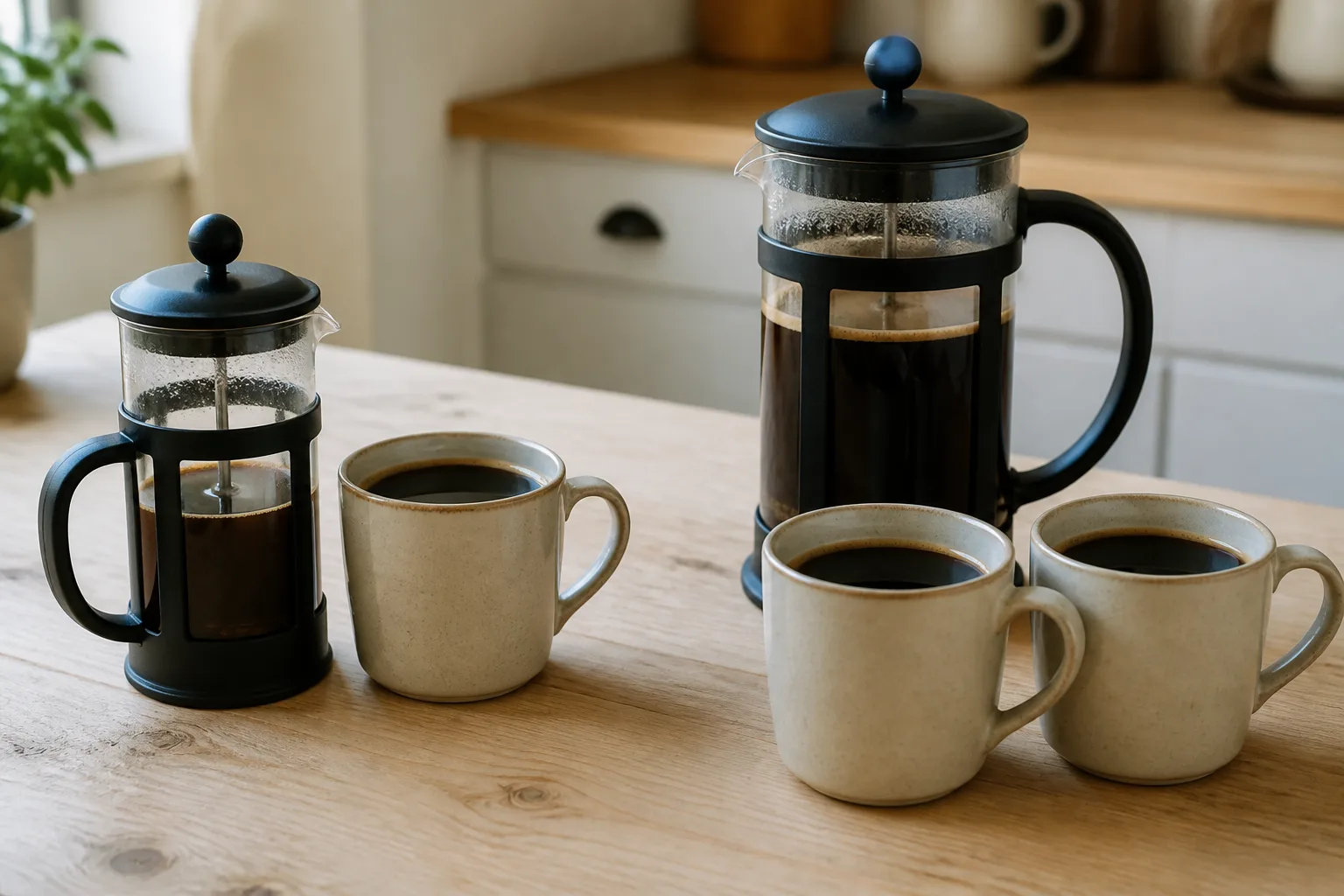
What 3-Cup, 8-Cup and 12-Cup Actually Mean
A cafetiere cup is not a UK mug
The number on a cafetiere is a product convention, not a promise of full-size mugs. In this category, one “cup” commonly works out at roughly 120–125ml. That is closer to a small coffee cup than the mug most UK households reach for at breakfast.
This is why a 3-cup press can look surprisingly small in person. Three nominal cups of roughly 115ml produce a stated vessel capacity around 350ml, yet that is only enough for one generously filled mug after normal brewing losses. Likewise, an 8-cup press around 1 litre does not usually fill eight mugs. It is better understood as a versatile two-person brewer.
Manufacturer ranges illustrate the convention. Bodum lists Chambord capacity in litres alongside its cup convention, so the volume gives the dependable comparison even when the marketing label feels counter-intuitive. Check the exact model rather than assuming all brands define a cup identically.
Stated capacity is not finished coffee
The headline capacity is normally the vessel’s maximum or nominal volume. In real use, you need room for ground coffee, water and the plunger assembly. Grounds absorb and retain some liquid, and a small amount remains trapped below the filter or in the spent coffee bed.
The difference is not a flaw; it is simply how immersion brewing works. A 1-litre press should therefore be planned as a brewer for somewhat less than a litre of drinkable coffee. The exact loss changes with dose, grind, roast and how firmly you drain the press, which is why a single guaranteed yield would be misleading.
Cafetiere Sizes Compared
3-cup cafetiere: best for one mug
A 3-cup cafetiere is the compact choice. At roughly 350ml stated capacity, it is well matched to one person who wants a normal mug rather than repeated small servings. It heats quickly, occupies little cupboard space and is less wasteful when you rarely brew for anyone else.
Its limitation is obvious when company arrives. Two medium mugs can easily exceed its practical yield, and there is little spare volume for a second drink. It can also feel cramped if you prefer a very large mug or use a relatively high coffee dose.
Choose it if:
- you normally brew for one person;
- your measured mug is roughly 250–300ml;
- storage space is tight; or
- you value a fresh single brew over keeping coffee for a refill.
8-cup cafetiere: the best all-round size
An 8-cup press, commonly around 1 litre, is the strongest default for most households. It can handle two substantial mugs without operating at its absolute limit and still works for three smaller servings. The footprint remains reasonable, and replacement glass beakers and filters are usually easy to find in this popular format.
This is the size we would choose for a couple, for one person who likes a refill, or for a household whose brewing pattern changes across the week. It provides useful flexibility without the heat-loss and cleaning burden of an oversized 12-cup vessel.
The main risk is buying by label and expecting eight ordinary mugs. Measure your actual serving volume first. If two people each use a 400ml mug, a nominal 1-litre press may be only just adequate after grounds retain water.
12-cup cafetiere: best for groups
A 12-cup cafetiere is often around 1.5 litres. It earns its space when four or more people regularly want coffee together, or when a family breakfast involves several mugs served at once. It also reduces the need to repeat the brew for guests.
For one or two drinkers, however, it is usually excessive. A large glass surface loses heat faster, the press is heavier to pour, and the tall beaker needs more sink and cupboard space. Brewing a small amount in it can work, but the plunger geometry and wider thermal mass make a correctly sized press more pleasant for daily use.
Buy the 12-cup version because you genuinely need group volume, not because the larger number looks like better value.
Which Cafetiere Size Should You Buy?
One person or one large mug
Start with a 3-cup model if your measured mug holds no more than about 300ml and you rarely want a refill. Move to an 8-cup press if your mug is unusually large, you routinely drink two servings, or you want enough room to brew without filling the vessel near its brim.
A smaller press also makes it easier to keep the dose and water consistent. Pair it with a grinder that can produce an even coarse setting; our guide to the best coffee grinders for French press explains why a large hopper is unnecessary for a single serving but useful for bigger batches.
Two people
Choose an 8-cup, roughly 1-litre cafetiere. It is the simplest recommendation in this guide because it covers two normal mugs with enough room for coffee and the plunger. If both people use very large mugs, measure them: you may discover that your combined target is closer to a litre before allowing for retained liquid.
Family breakfast or entertaining
Choose a 12-cup model when you regularly serve four or more mugs together. For three people, the decision depends on mug size: an 8-cup press can cover three modest servings, while a 12-cup press gives safer headroom for large mugs or seconds.
An insulated stainless-steel version becomes more attractive at this capacity because pouring four servings takes time and the final cup should not be noticeably cooler than the first. If group brewing is occasional, an 8-cup press plus a second brew may be a better use of cupboard space.
A simple decision checklist
Before buying, answer these questions:
- How many people drink coffee at the same time?
- How many millilitres does each real mug hold?
- Does anyone normally want a refill?
- Will the press fit under the cupboard and inside the dishwasher or sink?
- Do you need the coffee to stay hot while several people are served?
That five-minute check is more reliable than any cup label.
Coffee Dose, Headspace and Brewing Half-Full
Scale the dose with the water
Changing cafetiere size does not mean changing the strength. Scale coffee and water together. The Specialty Coffee Association uses 60g of coffee per litre as a useful reference point for filter-style brewing; individual taste, roast and grinder performance may lead you higher or lower. Our coffee-to-water ratio guide shows how to adjust systematically rather than guessing by spoonfuls.
As a starting illustration, 350ml of water at 60g per litre needs about 21g of coffee, 1 litre needs about 60g, and 1.5 litres needs about 90g. Those figures describe water and dose, not finished beverage yield. Use scales if repeatability matters, because coffee scoops vary dramatically with bean size and roast.
Leave workable headspace
Do not fill the beaker to the lip. The coffee crust rises during brewing, and the lid and plunger occupy space. A little headroom makes stirring, fitting the lid and plunging safer. Follow the maximum-fill guidance supplied with your exact press where available.
Overfilling creates more than a messy worktop. Hot liquid can escape as the plunger enters the beaker, and forcing a tight plunger through an overfull glass press is unnecessary risk. A slightly larger cafetiere is preferable if your normal dose regularly pushes a smaller one to its limit.
Can you brew a large cafetiere half-full?
Usually, yes, provided the filter travels low enough to meet the coffee and the manufacturer does not specify otherwise. Immersion extraction depends mainly on coffee, water, grind and time, so a correctly scaled half batch can taste fine.
There are practical drawbacks. A large vessel exposes more surface area and can lose heat faster, while some plungers leave more space below the filter than others. It is also harder to judge a small amount in a tall beaker. If you make half batches most days, that is evidence you bought a press larger than you need.
Glass vs Insulated Cafetieres
Glass presses
Glass cafetieres let you see the fill level, coffee crust and plunger position. They are usually lighter and cheaper, and a standard beaker can often be replaced after breakage. For a 3-cup or 8-cup brew served immediately, glass is a sensible default.
Their weaknesses become more noticeable at large capacity. More exposed glass means faster heat loss, and a full 1.5-litre beaker is heavy. Thermal shock and knocks against the sink are also concerns, so follow the manufacturer’s temperature and cleaning instructions.
Insulated stainless-steel presses
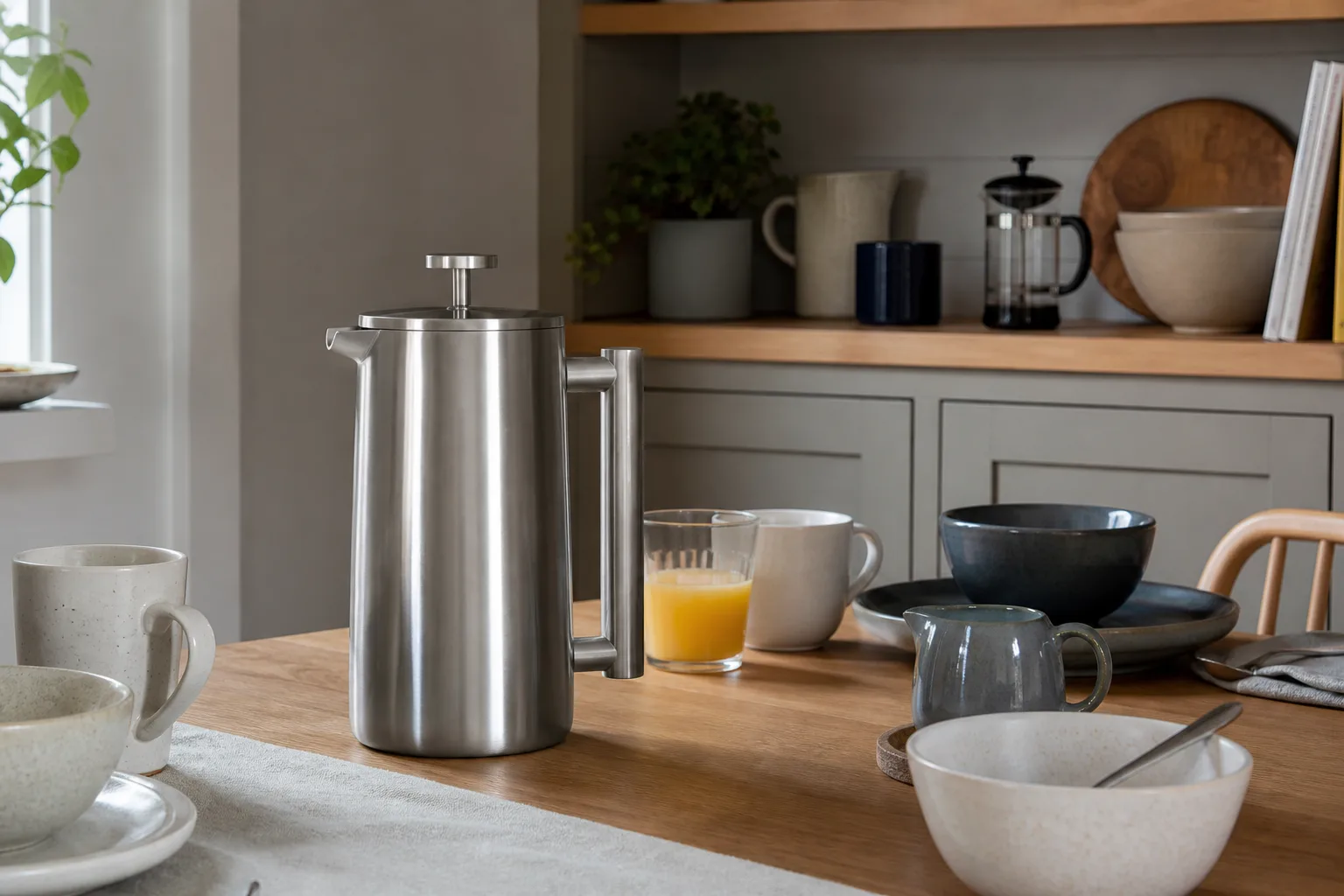
An insulated press is useful when a large batch sits for several minutes while breakfast is served. It retains heat better, resists breakage and is well suited to busy households or outdoor use. The opaque body means you cannot see the coffee level, and stainless models generally cost more and weigh more than glass equivalents.
Insulation does not make it wise to leave brewed coffee sitting on the grounds indefinitely. Pour the drink once it is ready; extended contact can make the later cups taste harsher. The pour-over, French press and AeroPress comparison is useful if clean-up, sediment or serving speed matters as much as capacity.
Storage, Cleaning and Daily Practicality
Capacity affects the whole routine, not just the amount of coffee. A 12-cup press needs a tall shelf, more room in the sink and a steady two-handed pour when full. A 3-cup model is easier to store but its narrow beaker can be awkward for larger hands to clean.
Check these details before buying:
- Height with plunger raised: the press must fit where you intend to brew it.
- Beaker opening: wider vessels are easier to rinse and brush.
- Filter removal: the mesh assembly should unscrew without a fight.
- Replacement parts: a replaceable beaker or mesh extends useful life.
- Dishwasher guidance: follow the exact manufacturer’s instructions rather than assuming every component is safe.
Coffee oils collect on the mesh and can make fresh coffee taste stale. Empty the grounds promptly, separate the filter periodically and dry all parts before reassembly. Our detailed guide to cafetiere cleaning and mesh-filter care covers the routine without damaging the screen.
Think about waste as well. A press that is too large encourages you to make more coffee than you drink; one that is too small encourages a second full brewing cycle. The right size is the one that matches your normal morning, not the biggest gathering you host once a year.
The Bottom Line
For one normal mug, buy a 3-cup cafetiere of roughly 350ml. For two people or one drinker who wants flexibility, buy an 8-cup model around 1 litre; it is the best all-round choice. Reserve a 12-cup, roughly 1.5-litre press for households and occasions where four or more mugs are genuinely needed.
Ignore the cup label until you have checked the stated millilitres. Measure your mugs, add their volumes, then allow room for grounds, retained liquid and the plunger. That simple calculation prevents both the disappointing one-mug “8-cup” surprise and the oversized press that spends most of its life half-empty.
Frequently Asked Questions
How many mugs does a 3-cup cafetiere make?
A typical 3-cup cafetiere is about 350ml, so it usually suits one normal UK mug rather than three mugs. Finished yield will be lower than the stated capacity because grounds retain some liquid.
Is an 8-cup cafetiere enough for two people?
Usually, yes. An 8-cup press is commonly around 1 litre and is the best default for two normal mugs. Measure unusually large mugs before buying, as two 400ml servings leave less headroom.
How many mugs does a 12-cup cafetiere make?
A 12-cup model is often around 1.5 litres and commonly covers four to five mugs, depending on mug size and brewing losses. Check the exact stated capacity because brands differ.
Can I make one cup in an 8-cup cafetiere?
Usually, provided the plunger reaches low enough and you scale coffee and water together. It can lose heat faster than a correctly sized small press, so a 3-cup model is more convenient if you brew one mug every day.
Should I buy a glass or stainless-steel cafetiere?
Glass is a good default for smaller brews served immediately because it is lighter and lets you see the fill level. Insulated stainless steel is better for large batches, slower serving and households concerned about breakage.
Why is my finished coffee less than the cafetiere capacity?
The stated capacity does not account for the space occupied by grounds and the plunger or the water retained in the spent coffee bed. Some liquid also remains below the filter, so finished yield is naturally lower.