De’Longhi is the best starting point for easy, good-value automatic coffee; Sage is the stronger choice if you want to learn espresso; Jura is the premium option when push-button consistency matters more than price. That brand verdict is more useful than comparing logos, because the three ranges are built around different levels of effort. The machines below show those differences clearly without pretending that every model within a brand works in the same way.
Quick verdict: De’Longhi vs Sage vs Jura
- Choose De’Longhi for the widest spread of accessible automatic and assisted-manual machines.
- Choose Sage when you want a portafilter workflow, grinder adjustment and hands-on milk steaming.
- Choose Jura when you want a polished automatic workflow and accept a substantial price premium.
- Best-value automatic: De’Longhi Magnifica S.
- Best assisted manual: Sage Barista Express Impress.
- Best premium automatic: Jura E8 Piano White.
Quick navigation
- How we compared
- Comparison at a glance
- Five machines that show the brand differences
- Which brand suits you?
- Espresso, milk and grinder differences
- Ownership, cleaning and servicing
- Frequently asked questions
- The bottom line
How we compared
We compared the three brands through five current UK machines rather than making blanket claims from one flagship. The criteria were workflow, grinder arrangement, milk system, cleaning, adjustment, footprint and the compromises created by each design. Automatic machines were judged as automatic machines; they were not marked down simply because they offer less manual control. Likewise, manual machines were not treated as better merely because they demand more technique.
This is a specification-led comparison. We checked current manufacturer information and exact product identities, then qualified claims that vary by drink, bean, user skill or maintenance. We have not assigned café-quality scores, predicted a fixed lifespan or repeated specific failure timelines. Those claims sound precise but are not dependable across different water, use and servicing conditions.
Comparison at a glance
| Machine | Best for | Workflow | Milk | Position |
|---|---|---|---|---|
| De’Longhi Magnifica S | Best-value automatic | Automatic bean-to-cup | Manual milk frother | Value |
| De’Longhi La Specialista Arte Evo | Best De’Longhi manual option | Assisted manual with grinder | Manual steam wand | Mid-range |
| Sage Barista Express | Best Sage value | Manual with grinder | Manual steam wand | Upper mid-range |
| Sage Barista Express Impress | Best assisted manual option | Assisted manual with grinder | Manual steam wand | Premium |
| Jura E8 Piano White | Best premium automatic | Automatic bean-to-cup | Automatic milk system | Luxury |
The table uses relative positions because retailer prices move. More importantly, the Magnifica S and Jura E8 are automatic bean-to-cup machines, while both Sage models and the Arte Evo use a portafilter. They are alternatives for different buyers, not five interchangeable versions of the same appliance.
Five machines that show the brand differences
1. De’Longhi Magnifica S: best-value automatic
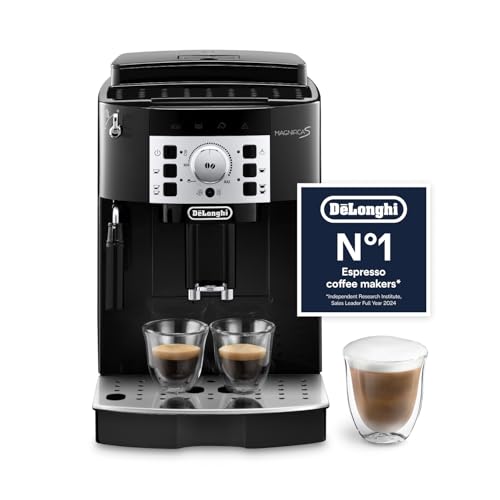
The Magnifica S explains De’Longhi’s appeal. It grinds beans, brews one or two coffees and provides a manual frother in a relatively compact automatic format. Thirteen grinder settings give useful adjustment without turning the morning drink into a hobby. The removable brewing unit also makes routine rinsing easier to understand than on sealed systems. Drink choice and interface are basic beside the Jura, but that restraint is part of the value: it covers espresso, longer coffee and milk drinks without charging for a large screen or elaborate menu.
- Buy it if: you want simple bean-to-cup coffee and a removable brew unit.
- Skip it if: you expect one-touch milk drinks or detailed drink customisation.
- Main compromise: the manual frother and simple controls require more involvement than a premium automatic.
2. De’Longhi La Specialista Arte Evo: best De’Longhi manual option

The Arte Evo is not a one-touch bean-to-cup machine. Its integrated grinder doses into a portafilter, after which you tamp, lock in, brew and steam milk yourself. Eight grind settings and three temperature profiles provide useful adjustment, while the cold-extraction programme adds a quick cold-coffee option. That drink is not the same process as traditional immersion cold brew, but it broadens the machine’s everyday use. Choose it over a De’Longhi automatic only if the preparation ritual is part of the attraction.
- Buy it if: you want De’Longhi convenience around a genuinely hands-on portafilter workflow.
- Skip it if: you want one-touch drinks or a grinder with very fine adjustment steps.
- Main compromise: the integrated grinder is tidy but limits the upgrade path.
3. Sage Barista Express: best Sage value

The Barista Express is the clearest expression of Sage’s home-barista approach. It combines a conical burr grinder, 54mm portafilter, low-pressure pre-infusion and manual steam wand, but leaves distribution, tamping, extraction timing and milk texture to you. Sage may describe this family as bean to cup, yet it is not automatic in the way the Magnifica S or Jura E8 is. It suits someone willing to learn why grind, dose and yield interact. The integrated grinder keeps the station compact, though a separate grinder would offer more flexibility later.
- Buy it if: you want to learn espresso without buying a separate grinder immediately.
- Skip it if: speed and repeatability matter more than technique.
- Main compromise: the all-in-one format is convenient but ties the grinder and brewer upgrade paths together.
4. Sage Barista Express Impress: best assisted manual option
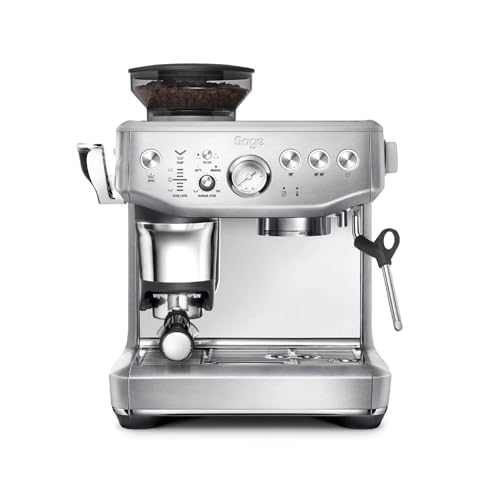
The Express Impress keeps a portafilter workflow but reduces two common beginner frustrations. Its intelligent dosing system adjusts the next grind after reading the previous dose, while the assisted lever applies a repeatable tamp. You still choose settings, lock in the portafilter, start extraction and texture milk. That makes it a useful middle ground between the ordinary Barista Express and a fully automatic machine. The assistance helps consistency, but it does not remove the need to adjust for different beans or learn milk steaming.
- Buy it if: you want manual espresso with help around dosing and tamping.
- Skip it if: you want automatic milk or dislike cleaning a portafilter after each drink.
- Main compromise: you pay more for assistance rather than a fundamentally different brewing format.
5. Jura E8 Piano White: best premium automatic

The Jura E8 is the convenience-led choice. It grinds, brews and prepares milk drinks through a guided interface, with adjustable strength and drink settings depending on the selected recipe. Jura’s brewing system and milk cleaning routines are designed as an integrated platform rather than a collection of user-serviceable parts. That produces a polished daily workflow, but it also means accepting Jura-specific maintenance and a much higher purchase position. Current UK availability can be thinner than for De’Longhi or Sage, so the E8 should be chosen for its automatic experience rather than brand prestige alone.
- Buy it if: you want premium push-button drinks and minimal preparation technique.
- Skip it if: you value a removable brew group, manual control or easy third-party servicing.
- Main compromise: the price premium is substantial and ownership remains maintenance-dependent.
Which brand suits you?
Choose De’Longhi for accessibility
De’Longhi covers the broadest range of workflows here. The Magnifica S makes automatic coffee approachable, while the Arte Evo offers a portafilter and steam wand without requiring a separate grinder. This makes De’Longhi the easiest brand to recommend before a buyer has decided between convenience and craft. Our espresso-machine workflow guide shows how much the daily routine changes.
Choose Sage to learn espresso
Sage is the stronger fit when the process matters. Both shortlisted machines require the user to handle the portafilter and steam milk. The Express Impress reduces dosing and tamping inconsistency, while the ordinary Express costs less and leaves more technique in your hands. If a separate grinder is acceptable, compare these with the options in our espresso machines under £500 guide.
Choose Jura for premium automation
Jura is for the buyer who values a refined automatic routine and is comfortable with brand-specific cleaning and servicing. The E8 is not automatically the best-tasting choice for every bean or drink, and it does not replace the control of a well-used manual setup. It is the best fit when consistency, drink menus and low preparation effort justify the premium. For more alternatives, see our best bean-to-cup machines.
Espresso, milk and grinder differences
Automatic and portafilter espresso are different
The Magnifica S and Jura E8 compress grinding, dosing and brewing into an automatic cycle. The Sage machines and Arte Evo expose more variables through a portafilter. A skilled user can adjust a manual setup more precisely, but that potential is not the same as guaranteed quality. Automatic machines trade some control for repetition and speed. Our bean-to-cup vs espresso machine guide explains the daily difference.
Milk systems change the routine
The Jura handles milk automatically, the Magnifica S uses a manual frother, and the three assisted-manual machines use steam wands. Automatic milk is easier to repeat but requires careful cleaning of hoses and connectors. Manual steaming allows direct texture control but needs practice. Neither system is universally better: cappuccino convenience and latte-art control are different goals.
Integrated grinders have limits
Every shortlisted machine includes a grinder, but adjustment range and access differ. The key exception in the wider Sage range is the Dual Boiler: it does not include a grinder and must be paired with one. That matters because the original article incorrectly grouped it with integrated-grinder models. Our espresso grinder guide covers why small adjustment steps matter more than headline speed.
Ownership, cleaning and servicing
Daily cleaning
All five machines need fresh-water management, drip-tray emptying and milk cleaning. Portafilter machines also need basket rinsing and puck disposal; automatic machines add internal rinse cycles and, where fitted, milk-system cleaning. Convenience changes where the work happens—it does not remove it. Our coffee-machine maintenance guide covers the routine.
Descaling and water hardness
Follow the exact manufacturer instructions for water hardness, filters and descaling. A universal timetable is unreliable because local water, drink volume and filter use differ. De’Longhi provides model-specific help through its UK support contact page, while Sage and Jura publish their own machine instructions and cleaning programmes.
Longevity claims need caution
No responsible comparison can promise that one brand will last a fixed number of years. Usage, water, cleaning, parts availability and repair decisions all matter. The useful distinction is service model: De’Longhi often provides removable brewing components on automatics, Sage manual machines expose familiar cleaning tasks, and Jura uses a more closed integrated system. Check warranty and authorised service terms for the exact model before buying.
Frequently asked questions
Is De’Longhi, Sage or Jura best for beginners?
De’Longhi is easiest for beginners who want automatic coffee. Sage suits beginners who actively want to learn espresso. Jura is easiest to operate but carries a much higher price position.
Is Sage better than De’Longhi for espresso?
Sage gives the user more direct control through a portafilter workflow, while De’Longhi spans both automatic and assisted-manual machines. Better depends on skill and desired effort.
Is Jura worth the premium?
It can be when automatic drink choice, consistency and a polished interface are priorities. It is harder to justify if manual control, removable components or value matter more.
Does the Sage Dual Boiler have a grinder?
No. The Sage Dual Boiler is a standalone espresso machine and requires a separate espresso-capable grinder.
Can Jura machines use pre-ground coffee?
Some Jura models include a bypass chute for pre-ground coffee, but capability varies by model. Check the exact E8 manual rather than assuming every Jura works identically.
Which brand is easiest to clean?
No brand removes cleaning. De’Longhi removable brew groups can simplify rinsing, Sage portafilters make daily tasks visible, and Jura relies more heavily on guided programmes and approved maintenance products.
The bottom line
Choose De’Longhi for accessible value and the broadest choice of workflows, Sage for hands-on espresso, and Jura for premium automation. The Magnifica S is the best-value automatic here, the Barista Express is the best-value manual route, the Express Impress adds useful assistance, and the Jura E8 is the convenience-led luxury option. Decide first whether you want to operate a portafilter or press a button; brand comes second.